

How Do Credit Card Rewards Work? They turn some of your everyday card spending into points, miles, or cash back. However, rewards only help when you understand the rules, pay your bill on time, and avoid spending extra just to earn bonuses.
Credit card rewards can look confusing at first. One card may offer 2% cash back, another may give 3 points per dollar, while a travel card may advertise a large welcome bonus. Therefore, the real question is not simply how many rewards you can earn. It is how much those rewards are actually worth after fees, interest, and redemption rules.
The Consumer Financial Protection Bureau (CFPB) reports that consumers earned $47.5 billion in credit card rewards during 2024, nearly twice the amount earned in 2020. Points cards generated $23.9 billion, cash-back cards generated $16.6 billion, and miles cards generated $6.6 billion.
So, rewards are a major part of the credit card market. Still, they are not free money.
How Do Credit Card Rewards Work?
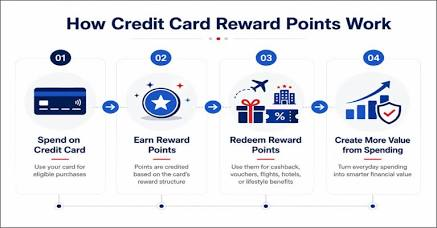
How Do Credit Card Rewards Work? Most programs follow a simple pattern: you make an eligible purchase, your card tracks the transaction, and the issuer adds rewards according to its earning rate.
For example, suppose a card pays 2% cash back. If you spend $500 on eligible purchases, you could earn $10.
The basic formula is:
Eligible spending × rewards rate = rewards earned
However, cards often use different rates for different purchases. A card might offer 1% on general purchases but 3% on groceries, dining, or travel.
The Three Main Reward Types
Most credit card reward programs use three main currencies:
- Cash back
- Points
- Miles
The CFPB identifies these as the primary reward types.
Each type works differently, so your best choice depends on how you normally spend and how you want to use your rewards.
How Cash-Back Rewards Work
Cash back is usually the easiest system to understand.
You spend money with your card and receive a percentage back. For instance, a 1.5% cash-back card could return $15 when you spend $1,000 on eligible purchases.
You may receive rewards as a statement credit, bank deposit, check, or another option offered by the issuer.
Therefore, cash back can work well for people who want simple rewards without tracking airline or hotel programs.
How Points Rewards Work
Points can be more flexible.
A card might award 1, 2, 3, or more points for each eligible dollar. You can then use those points for travel, cash back, gift cards, merchandise, or other options.
However, the value of one point can change depending on how you redeem it. The CFPB notes that point values can vary by redemption choice.
How Miles Rewards Work
Miles usually connect to travel programs.
A travel card may award airline miles directly, or it may offer transferable points that you can move to airline or hotel partners.
As a result, miles can be valuable for frequent travelers. However, they can also require more planning than cash back.
How Do Credit Card Rewards Work With Spending Categories?
How Do Credit Card Rewards Work? They often depend on the type of purchase you make.
Some cards use a flat reward rate. Others use bonus categories.
For example:
| Purchase type | Example earning rate | $1,000 spending |
| General purchases | 1% | $10 |
| General purchases | 1.5% | $15 |
| Bonus category | 3% | $30 |
| Higher bonus category | 5% | $50 |
These numbers are examples, not promises from a particular card.
Before choosing a card, check which purchases qualify.
How Do Credit Card Rewards Work With Bonus Categories?
How Do Credit Card Rewards Work? With category bonuses, the answer depends on the merchant and purchase code.
A card might advertise a higher rate for restaurants, supermarkets, gas stations, or travel. Yet not every business you expect may qualify.
For example, a purchase inside a hotel may not always receive the same reward rate as a direct hotel charge.
Therefore, always read the issuer’s reward terms.
How Do Credit Card Rewards Work With Welcome Bonuses?
How Do Credit Card Rewards Work? Welcome bonuses usually require you to spend a certain amount during a specific period.
Imagine a fictional card offering:
50,000 points after spending $3,000 within 90 days.
You do not automatically receive the bonus simply because you opened the account.
Instead, you must meet the stated spending requirement.
The CFPB says sign-up bonuses are a common form of promotional rewards.
The Hidden Math Behind a Welcome Bonus
A large bonus can look exciting. However, you should ask a simple question:
Would I spend this much money anyway?
If your normal monthly spending is $800, spending $3,000 quickly just to earn points could create a problem.
Therefore, never buy unnecessary things only because a bonus is available.
A reward is not a reward if it pushes you into expensive credit card debt.
How Do Credit Card Rewards Work With Annual Fees?
How Do Credit Card Rewards Work? You must consider the card’s annual fee before calling the rewards valuable.
Suppose a card earns $300 worth of rewards each year but charges a $150 annual fee.
Your simple reward difference would be:
$300 − $150 = $150
However, you should also consider other benefits, such as travel credits or insurance, if they genuinely help you.
How Do Credit Card Rewards Work With Interest?
How Do Credit Card Rewards Work? They can become a bad deal when interest charges outweigh your rewards.
Suppose you earn $20 in cash back but carry a balance that creates $80 in interest.
You are not really ahead by $20.
The CFPB warns that consumers who carry revolving balances can pay far more in interest and fees than they receive in rewards.
Therefore, paying your balance on time is usually more important than maximizing rewards.
Why Paying in Full Matters
A smart rewards strategy starts with responsible card use.
If possible, pay your statement balance in full by the due date.
That way, you can enjoy the reward system without allowing interest to eat away at your benefit.
Also, remember that a rewards card is still a credit card. Rewards do not change that basic fact.
How Do Credit Card Rewards Work With Minimum Payments?
How Do Credit Card Rewards Work? Rewards generally come from eligible purchases, not from making a minimum payment.
A minimum payment helps keep your account current, but it does not make carrying a balance profitable.
For example, earning $30 in rewards while paying interest for several months can quickly destroy the value of those rewards.
Therefore, focus on the total cost of using the card.
How Do Credit Card Rewards Work After a Purchase?
How Do Credit Card Rewards Work? The rewards usually appear after an eligible transaction posts to your account.
However, some transactions may take time to qualify.
Returns, refunds, canceled purchases, balance transfers, cash advances, fees, and other transactions may have different treatment.
Because every program has its own rules, check your card’s reward agreement.
How Do Credit Card Rewards Work With Refunds?
How Do Credit Card Rewards Work? If you return something, the issuer may remove the rewards you earned from that purchase.
For example, you spend $200 and earn 2% cash back, or $4. If you later return the item, the issuer can generally reverse the reward under the program rules.
So, do not treat pending rewards as guaranteed money.
How Do Credit Card Rewards Work With Gift Cards?
How Do Credit Card Rewards Work? Some programs let you exchange points for gift cards.
This option can be convenient. However, the value may differ from the value available through travel or cash redemption.
Suppose 10,000 points can produce $100 in one redemption option but only $50 in another.
The same points have not changed in quantity. Their redemption value has changed.
How Do Credit Card Rewards Work for Travel?
How Do Credit Card Rewards Work? Travel rewards can become more complicated because points or miles may have different values for different flights and hotels.
NerdWallet’s 2026 research explains that point and mile values depend on the specific program and redemption method. Its research analyzed millions of travel prices across hotel loyalty programs.
Therefore, compare the cash price with the points price before booking.
Understanding One-Cent-Per-Point Math
A useful starting point is 1 cent per point.
For example:
10,000 points × $0.01 = $100
However, this is only a simple benchmark.
Some points may provide less value. Others may provide more, especially when transferred to travel partners or used during favorable promotions.
NerdWallet similarly describes 1 cent per point as a general rule of thumb, while noting that actual values can be higher or lower.
How Do Credit Card Rewards Work With Transfer Partners?
How Do Credit Card Rewards Work? Some programs allow you to transfer points to participating airline or hotel loyalty programs.
This can create extra flexibility.
However, transfers may have rules, minimum amounts, or specific ratios.
For that reason, do not transfer points until you have identified the booking you want.
How Do Credit Card Rewards Work When Values Change?
How Do Credit Card Rewards Work? The value is not always fixed forever.
The CFPB has warned about reward devaluation, limited redemption options, unclear terms, and changes to previously advertised benefits.
Therefore, avoid collecting huge balances for years without a plan.
Use rewards regularly when that makes financial sense.
Reading the Fine Print
Reward advertisements show the exciting part first.
However, the important details often sit in the terms.
Look for:
- Spending requirements
- Bonus deadlines
- Annual fees
- Reward caps
- Eligible categories
- Redemption minimums
- Expiration rules
- Account closure rules
- Transfer rules
- Excluded transactions
The CFPB has specifically highlighted problems involving vague or hidden reward conditions.
How Do Credit Card Rewards Work When Rewards Expire?
How Do Credit Card Rewards Work? Expiration depends on the specific program.
Some rewards may remain available while the account stays open and in good standing. Others can have different rules.
Therefore, check the current terms instead of assuming that your points will remain forever.
The CFPB has received reports from consumers about rewards disappearing under expiration policies or after account closure.
How Do Credit Card Rewards Work After Closing a Card?
How Do Credit Card Rewards Work? Closing an account can affect unused rewards.
The result depends on the issuer and program.
Before closing a rewards card, check whether you must redeem or transfer your points first.
This small step can prevent an unpleasant surprise.
Real-Life Example: A Simple Cash-Back Card
Imagine Maria spends $1,500 each month on normal household expenses.
Her card provides 2% cash back.
Her estimated annual spending is:
$1,500 × 12 = $18,000
At 2%:
$18,000 × 0.02 = $360
If the card has no annual fee and Maria pays her balance in full, that could provide a simple $360 annual reward.
However, if she pays large interest charges, the result could become negative.
Case Study: When a Big Bonus Goes Wrong
Consider James.
He finds a card offering a large welcome bonus after $4,000 of spending.
Normally, he spends only $1,000 each month.
Instead of waiting, he buys things he does not need.
He earns the bonus but cannot pay the bill in full.
Now interest charges begin.
The lesson is simple: a bonus should fit your normal budget, not force your budget to fit the bonus.
Case Study: A Better Rewards Strategy
Now consider Sara.
She already spends money on groceries, transportation, bills, and regular household purchases.
She chooses a card whose reward categories match those expenses.
She does not change her lifestyle.
She pays the statement balance each month.
As a result, she earns rewards from spending she already planned to do.
That is a much healthier rewards strategy.
How Do Credit Card Rewards Work for Families?
How Do Credit Card Rewards Work? Families can sometimes earn rewards quickly because they have more regular household spending.
However, higher spending does not automatically mean better results.
A family should first create a budget.
Then, it can choose a rewards card that matches genuine expenses.
Never use rewards as a reason to increase unnecessary spending.
How Do Credit Card Rewards Work for Beginners?
How Do Credit Card Rewards Work? Beginners should start with simplicity.
A straightforward cash-back card may be easier to manage than a complicated travel program.
Start by learning:
- Your reward rate.
- Your annual fee.
- Your due date.
- Your interest rate.
- Your redemption options.
After that, you can explore more advanced strategies.
Advantages of Credit Card Rewards
Rewards can provide several useful benefits.
Main advantages
- You can earn money back on normal purchases.
- You may receive travel rewards.
- You can sometimes earn valuable welcome bonuses.
- Points may provide flexible redemption choices.
- Rewards can add value without changing your spending.
- Some cards offer extra benefits alongside rewards.
However, these advantages only matter when the card fits your financial habits.
Disadvantages You Should Know
Rewards also have real disadvantages.
Common problems
- Annual fees can reduce your gains.
- Interest can erase rewards quickly.
- Bonus categories can be confusing.
- Points may lose value.
- Rewards may have restrictions.
- Some programs have complicated rules.
- Closing an account can affect unused rewards.
- A large bonus may encourage overspending.
The CFPB has documented consumer concerns about reward devaluation and redemption restrictions.
How Do Credit Card Rewards Work in a Monthly Budget?
How Do Credit Card Rewards Work? They work best when rewards fit inside your existing budget.
For example, if your food budget is $500, you should not increase it to $700 simply because a card gives bonus points.
Instead, keep the $500 budget.
Then earn rewards on the spending you already planned.
This approach protects your finances while still letting you benefit from the card.
How Do Credit Card Rewards Work With Credit Scores?
How Do Credit Card Rewards Work? Rewards themselves do not replace good credit habits.
Your credit profile can be affected by factors such as payment history and credit utilization.
Therefore, do not open multiple cards simply because they offer attractive bonuses.
Think about the long-term effect of every account.
Expert Advice: Focus on Net Value
A useful way to compare rewards cards is:
Net value = rewards + useful benefits − annual fees − interest − other costs
This is more useful than simply comparing advertised reward rates.
For example, a 5% card may look better than a 2% card. Yet if the 5% rate applies only to a small category with a cap, the difference may be smaller than expected.
Expert Advice: Check the Issuer’s Rules
Always read the current reward agreement before applying.
The CFPB explains that credit card companies can change certain account terms, while some changes to rewards may receive different treatment from major interest-rate or fee changes.
Therefore, do not rely on an old advertisement or a social media post.
How Do Credit Card Rewards Work for Taxes?
How Do Credit Card Rewards Work? In the United States, ordinary purchase-based credit card rewards are generally treated differently from wages or investment income.
An IRS legal memorandum has concluded that certain credit card rewards redeemable for cash, statement credits, or goods and services can be treated as rebates or similar payments.
However, tax treatment can vary based on how rewards are earned.
If rewards involve business payments, promotional payments, referrals, or other unusual arrangements, consult a qualified tax professional.
A Simple Rewards Comparison Chart
| Feature | Cash Back | Points | Miles |
| Easy to understand | Excellent | Good | Moderate |
| Travel potential | Low to moderate | High | High |
| Flexible redemption | High | High | Moderate |
| Value stability | Usually higher | Varies | Varies |
| Best for | Simple rewards | Flexible users | Frequent travelers |
| Main risk | Low reward rate | Complex value | Changing travel value |
The best choice depends on your spending, goals, and ability to pay your balance.
How Do Credit Card Rewards Work in 2026?
How Do Credit Card Rewards Work? The basic model remains simple, but the market keeps changing.
Current CFPB market data shows that rewards cards now dominate general-purpose credit card spending. In 2024, cards without rewards represented about 20% of general-purpose accounts, down from 33% in 2015.
That means rewards are no longer a niche feature.
They are a major part of everyday card use.
A Practical Rewards Formula
You can use this quick calculation before applying:
Annual rewards = expected eligible spending × effective reward rate
Then calculate:
Real benefit = annual rewards + useful benefits − annual fee
Finally, consider interest.
If you regularly carry a balance, the interest cost may matter much more than the reward amount.
Five Mistakes to Avoid
Avoid these common mistakes:
- Chasing bonuses you cannot afford.
- Ignoring annual fees.
- Carrying a balance for rewards.
- Assuming every purchase earns the advertised rate.
- Saving points without checking program changes.
A simple strategy usually beats a complicated strategy that you cannot manage.
How Do Credit Card Rewards Work for Everyday Purchases?
How Do Credit Card Rewards Work? The simplest strategy is to use the card for purchases already included in your budget.
For example, you might use it for groceries, subscriptions, transportation, or regular bills when the merchant accepts the card and the purchase qualifies.
Then pay the statement balance.
This creates a clear connection between spending and rewards.
How Do Credit Card Rewards Work When You Redeem Them?
How Do Credit Card Rewards Work? Redemption turns your accumulated rewards into something useful.
Before clicking “redeem,” compare the choices.
Ask:
- How many points will I use?
- What dollar value will I receive?
- Is there a better redemption?
- Are there fees?
- Does the redemption have restrictions?
This quick check can make your rewards go further.
A Beginner’s Seven-Step Plan
If you are new to rewards, follow these steps:
- Choose one card you understand.
- Read its reward rules.
- Check the annual fee.
- Create a monthly spending limit.
- Never spend extra for points.
- Pay your statement balance on time.
- Redeem rewards for useful value.
After several months, review whether the card is actually helping you.
Official Resources and Address
For reliable information, start with the Consumer Financial Protection Bureau, which provides consumer guidance and research on credit cards and rewards.
Consumer Financial Protection Bureau — Credit Cards
CFPB mailing address: 1700 G Street NW, Washington, DC 20552, USA.
You can also review IRS information when tax questions arise.
For general educational information about points and miles, NerdWallet also publishes current valuation research.
Frequently Asked Questions
- How Do Credit Card Rewards Work for beginners?
How Do Credit Card Rewards Work? You make eligible purchases, earn rewards according to the card’s rules, and later redeem those rewards for cash, travel, points, or other benefits.
- Are credit card rewards really free money?
Not exactly. Rewards come from a card program, but fees, interest, restrictions, and spending requirements can reduce their value.
- Is cash back better than points?
It depends. Cash back is usually easier, while points may provide more flexibility or travel value.
- How much is one credit card point worth?
There is no universal value. One common benchmark is 1 cent per point, but actual value varies by program and redemption method.
- Can credit card rewards expire?
Yes, depending on the program’s rules. Always check the current terms.
- Can I lose rewards when I close a card?
You might. Rules differ by issuer and program, so check before closing the account.
- Do I earn rewards on every purchase?
Not always. Some transactions may be excluded, and bonus categories may have special rules.
- Can I use rewards to pay my credit card bill?
Some issuers allow statement credits or other forms of redemption. Check your card’s current options.
- Are travel points better than cash back?
Not automatically. Travel points can be more valuable for some people, but cash back offers simplicity.
- Should I chase a large welcome bonus?
Only if you can meet the spending requirement naturally and still pay the balance in full.
- Do rewards increase my credit score?
Rewards themselves do not improve your score. Responsible credit use matters more.
- What happens to rewards after a refund?
The issuer may reverse rewards earned from the refunded purchase.
- Can reward values change?
Yes. Programs can change redemption rules and values, subject to applicable laws and terms. The CFPB has specifically raised concerns about reward devaluation.
- Should I use several rewards cards?
You can, but only if you can manage them easily and avoid unnecessary spending.
- Are credit card rewards taxable?
The tax result depends on how you receive and earn the rewards. Ordinary purchase-related rewards can receive rebate-like treatment, while other situations may differ.
- Can I earn rewards while carrying a balance?
You may earn rewards, depending on the card. However, interest can easily outweigh those rewards.
- What is the safest rewards strategy?
Use the card for planned purchases and pay the statement balance in full.
- Are points better than miles?
Neither is automatically better. The right choice depends on your spending and redemption goals.
- How can I get more value from points?
Compare redemption options instead of automatically choosing the first option you see.
- What is the biggest credit card rewards mistake?
The biggest mistake is spending more or carrying debt just to earn rewards. The CFPB warns that interest and fees can outweigh rewards for people who carry balances.
Final Answer: Are Credit Card Rewards Worth It?
How Do Credit Card Rewards Work? In simple terms, you spend with a rewards card, the issuer calculates eligible rewards, and you later redeem those rewards for cash, points, miles, travel, or other benefits.
The smart part is knowing what happens between those steps.
Choose rewards that match your normal spending. Next, understand the earning rules. Then, check annual fees and redemption values. Most importantly, avoid carrying expensive debt simply to collect points.
Current market data shows just how large the rewards industry has become. U.S. consumers earned $47.5 billion in credit card rewards in 2024, according to the CFPB.
However, the biggest reward is not a giant points balance.
It is using a credit card without letting the credit card control your budget.
The best rewards strategy is simple: spend only what you planned, pay on time, understand the rules, and choose rewards that you will actually use.