

How Do Credit Cards Work for Beginners? A credit card lets you buy something now and pay the card company later. However, a credit card is not free money. It is a form of borrowing, and you must repay what you use.
At first, credit cards can seem confusing. You may see words such as APR, minimum payment, billing cycle, credit limit, statement balance, available credit, and grace period. Fortunately, these ideas become much easier once you understand how they connect.
In this guide, we will explain How Do Credit Cards Work for Beginners? in very simple language. You will learn how purchases work, when interest starts, why minimum payments matter, how credit cards can affect your credit score, and how to avoid common mistakes.
Most importantly, you will learn how to use a credit card as a useful financial tool instead of letting it become expensive debt.
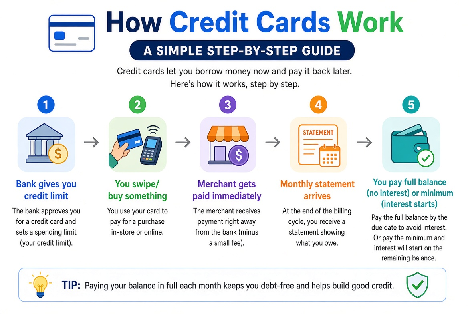
Quick answer: A credit card gives you access to a credit limit. You use part of that limit to make purchases, receive a bill later, and repay the amount you borrowed. If your card has a grace period and you pay the statement balance in full by the due date, you can usually avoid interest on purchases.
How Do Credit Cards Work for Beginners? Start Here
How Do Credit Cards Work for Beginners? The easiest way to understand them is to imagine a short-term borrowing account.
Suppose a bank gives you a credit card with a $1,000 credit limit. You buy $100 of groceries with the card.
You now owe the card issuer $100.
The bank does not normally take the $100 from your checking account immediately. Instead, the purchase goes onto your credit card account. Later, the bank sends you a statement showing what you owe.
You can then pay the amount according to the card’s terms.
For example:
- Credit limit: $1,000
- Purchase: $100
- Remaining available credit: about $900
- Statement balance: $100
- Minimum payment: a smaller required amount
- Payment due date: the date by which at least the minimum must be paid
If you pay the full statement balance by the due date and your card offers a grace period for purchases, you can generally avoid interest on those purchases.
What Exactly Is a Credit Card?
A credit card is a payment card linked to a revolving credit account.
When you use it, the card issuer pays the merchant according to the card network’s rules. You then owe the card issuer the amount charged.
Unlike a debit card, a credit card does not normally take money directly from your bank account when you make the purchase.
Instead, you borrow against your available credit.
For example, imagine you have a $2,000 limit.
You spend:
- $300 on groceries
- $100 on gas
- $200 on clothing
Your purchases total $600.
Therefore, you have about $1,400 of unused credit before considering pending transactions, fees, or other account activity.
You must eventually repay the $600.
Why Credit Cards Are Called Revolving Credit
Credit cards usually provide revolving credit.
That means you can borrow, repay, and borrow again as long as the account remains open and you stay within your available credit.
For example:
- You have a $1,000 limit.
- You spend $300.
- You have about $700 available.
- You repay $300.
- Your available credit can return to about $1,000.
- You can then use the card again.
This differs from many installment loans.
With an installment loan, you normally borrow a set amount and repay it through scheduled payments.
With a credit card, your balance can change every month.
That flexibility makes credit cards useful. However, it can also make overspending easy.
How Do Credit Cards Work for Beginners? Understand the Credit Limit
Your credit limit is the maximum amount the card issuer allows you to owe on the account at one time, subject to the card agreement.
For example, if your limit is $5,000, that does not mean you should spend $5,000.
It simply means the issuer has approved that amount of revolving credit.
Your limit can depend on factors such as:
- Your credit history
- Income information
- Existing debt
- Application information
- The lender’s risk rules
- Your relationship with the issuer
A higher limit does not mean you have more income.
That is an important beginner lesson.
If you earn $3,000 per month and receive a $10,000 credit limit, you should not think of $10,000 as extra income.
It is borrowed purchasing power.
Available Credit Is Different From Your Credit Limit
Many beginners confuse these two terms.
Your credit limit is the total amount the issuer allows you to use.
Your available credit is roughly how much of that limit remains available.
Suppose your credit limit is $3,000.
You have already charged $800.
Your available credit may be around $2,200, although pending transactions and fees can change the number.
The basic formula looks like this:
Available credit = credit limit − current balance
The exact amount can differ because of pending purchases, holds, fees, and other account activity.
How Do Credit Cards Work for Beginners? Meet the Billing Cycle
A billing cycle is the period during which your card issuer records transactions for a statement.
For example, imagine your billing cycle runs from June 1 through June 30.
During that period, you might make several purchases.
At the end of the cycle, the issuer creates your statement.
That statement can show:
- Purchases
- Payments
- Credits
- Fees
- Interest
- Statement balance
- Minimum payment
- Payment due date
The billing cycle is important because it helps you understand when purchases appear on your statement.
What Is a Credit Card Statement?
Your credit card statement is your monthly financial report for the account.
You should read it rather than simply looking at the amount due.
A statement may include:
- Previous balance
- New purchases
- Payments
- Refunds
- Fees
- Interest charges
- Statement balance
- Minimum payment
- Due date
- Credit limit
- Available credit
Your statement also helps you spot mistakes or unauthorized transactions.
Therefore, checking your statement every month is a simple but powerful habit.
The Consumer Financial Protection Bureau provides guidance on understanding credit card statements and important account terms.
Statement Balance vs. Current Balance
These terms can cause confusion.
Your statement balance is the amount shown on the statement at the end of the billing cycle.
Your current balance can change after the statement closes because you may make new purchases or receive credits.
For example:
- Statement closes at $500.
- You receive a $500 statement.
- The next day, you buy $50.
- Your current balance may now be $550.
However, that new $50 purchase may belong to the next billing cycle rather than the previous statement.
This distinction can make your credit card bill much easier to understand.
How Do Credit Cards Work for Beginners? Learn the Due Date
The payment due date tells you when the required payment must reach the issuer.
You should always know this date.
Missing the required payment can lead to:
- Late fees
- Interest costs
- Possible penalty terms
- Credit reporting problems if the payment becomes seriously delinquent
The CFPB explains that the minimum payment must be paid by the due date to keep the account current.
Therefore, beginners should set up reminders or automatic payments.
However, automatic payment works best when you keep enough money in the linked bank account.
What Is the Minimum Payment?
The minimum payment is the smallest amount you must pay by the due date to keep the account from being considered unpaid for that billing period.
The exact calculation depends on the card.
For example, a statement might show:
Balance: $1,000
Minimum payment: $35
Due date: August 25
Paying $35 may satisfy the minimum payment requirement.
However, it does not mean you paid off your debt.
You could still owe the remaining balance.
The CFPB advises consumers to pay more than the minimum when possible because paying only the minimum can increase interest costs and extend repayment time.
Why Paying Only the Minimum Can Become Expensive
Imagine you owe $2,000.
Your card requires a small minimum payment each month.
If you pay only the minimum, much of your payment may go toward interest and only part may reduce the principal balance.
As a result, the debt can take much longer to repay.
For example, imagine someone uses a card for a large purchase and then makes only small payments.
The balance can remain for many months or even years.
Meanwhile, interest can continue adding to the cost.
Therefore, the minimum payment should be treated as a safety floor, not a spending target.
How Do Credit Cards Work for Beginners? Understand APR
APR means Annual Percentage Rate.
In simple terms, it represents the yearly interest rate associated with borrowing, although the actual interest calculation follows the terms of the card agreement.
Credit cards can have different APRs for different types of transactions.
For example, a card may have separate rates for:
- Purchases
- Cash advances
- Balance transfers
- Certain promotional balances
The CFPB explains that credit card interest rates are generally stated as annual rates and that different balance categories can have different APRs.
APR Is Not the Same as a Monthly Fee
This is another common beginner mistake.
If a card has a 24% APR, that does not simply mean the bank charges exactly 2% every month in every situation.
Credit card issuers use specific methods described in the card agreement.
Many issuers calculate interest daily using a daily periodic rate and an account balance method.
Therefore, you should read the card’s terms instead of using a simple APR-divided-by-12 calculation as an exact prediction of your bill.
How Do Credit Cards Work for Beginners? The Grace Period
A grace period can help you avoid interest on purchases.
The CFPB defines it as the period between the end of a billing cycle and the payment due date. Credit card companies do not have to provide a grace period, but many cards offer one for purchases.
For example:
- You make purchases during a billing cycle.
- Your statement closes.
- The statement shows your balance.
- You pay the statement balance in full by the due date.
- If the card provides the applicable grace period, you can generally avoid interest on those purchases.
However, grace-period rules can vary.
Therefore, always read your specific card agreement.
Why Paying in Full Is So Powerful
Paying your statement balance in full each month can provide two major benefits.
First, it helps you avoid carrying unnecessary credit card debt.
Second, if your card has a grace period for purchases, it can help you avoid interest on those purchases.
The FTC recommends paying the full balance when possible because doing so can help you take advantage of a card’s grace period.
This is one of the best habits for a beginner.
A simple rule is:
Only charge what you can afford to pay when the bill arrives.
How Do Credit Cards Work for Beginners? What Happens When You Carry a Balance?
When you pay less than the full balance, you may carry the remaining amount into another billing period.
Interest may then apply according to your card agreement.
For example:
- Statement balance: $1,000
- Payment: $300
- Remaining balance: $700
The remaining balance may continue to generate interest.
Also, depending on the card’s terms and your grace-period status, new purchases may not receive the same interest-free treatment.
The CFPB notes that losing a grace period can affect interest on new purchases.
How Credit Card Interest Can Grow
Credit card interest can build over time.
Many issuers calculate interest daily.
Imagine you carry a balance for several months.
You may pay:
- The original purchases
- Interest on the balance
- Potential fees
- Additional interest depending on the account’s terms
That is why paying down high-interest credit card debt quickly can make a big difference.
Cash Advances Are Different From Purchases
A cash advance lets you use your credit card account to obtain cash.
However, cash advances often have different and less favorable terms than normal purchases.
They may have:
- A separate APR
- A cash advance fee
- No normal purchase grace period
- Interest beginning quickly
The CFPB notes that interest on cash advances generally starts from the transaction date rather than receiving the same purchase grace period.
Therefore, beginners should understand cash advance terms before using this feature.
What Is a Balance Transfer?
A balance transfer moves debt from one credit account to another.
Some cards offer promotional balance transfer rates.
However, balance transfers can have fees.
The CFPB notes that balance transfers generally involve a fee based on the amount transferred.
Therefore, never focus only on a promotional APR.
Instead, calculate the total cost, including:
- Transfer fee
- Promotional period
- Regular APR after promotion
- Required payments
- Other account fees
How Do Credit Cards Work for Beginners? Learn About Fees
Credit cards can have several types of fees.
Common examples include:
- Annual fees
- Late payment fees
- Balance transfer fees
- Cash advance fees
- Foreign transaction fees
- Certain returned-payment fees
Not every card charges every fee.
Therefore, check the card’s pricing and terms before applying.
A card with rewards may look attractive, but a high annual fee could reduce the value if you do not use its benefits.
Annual Fees Can Change the Value of a Card
An annual fee is a charge for keeping the card open for a year.
For example, imagine a card offers valuable rewards but charges $95 each year.
If you earn only $40 worth of useful rewards, the card may not be worth the fee for you.
On the other hand, another person may receive more than $95 in useful value.
The right card depends on your spending and needs.
Therefore, do not choose a card only because it offers rewards.
How Do Credit Cards Work for Beginners? Rewards Explained
Some credit cards offer rewards for eligible purchases.
Rewards may include:
- Cash back
- Points
- Travel rewards
- Store benefits
- Other promotional benefits
However, rewards do not make debt cheap.
Suppose a card gives you 2% cash back.
You spend $1,000 and earn about $20 in rewards.
If you then carry that $1,000 balance and pay substantial interest, the interest can easily outweigh the reward.
Therefore:
Never spend extra money just to earn rewards.
Credit Cards and Your Credit Score
Your credit card activity can affect your credit history and credit scores.
One major factor is payment history.
FICO says payment history accounts for 35% of a typical FICO Score calculation, although the importance of factors can vary by person.
That means paying bills on time is extremely important.
Another major factor is amounts owed.
FICO says amounts owed account for roughly 30% of a typical FICO Score, with credit utilization playing an important role.
How Do Credit Cards Work for Beginners? Credit Utilization
Credit utilization compares your card balance with your credit limit.
The basic calculation is:
Credit utilization = balance ÷ credit limit × 100
Suppose your card has:
- $2,000 limit
- $500 balance
Your utilization is:
$500 ÷ $2,000 × 100 = 25%
FICO explains that lower utilization generally tends to be better for scores, although there is no universal magic number that guarantees a particular score.
Therefore, avoid treating 30% as a guaranteed cutoff.
Why Maxing Out a Card Can Be Risky
Suppose you have a $1,000 limit.
You spend $950.
Your utilization is 95%.
Even if you plan to pay the card later, such a high balance can create problems.
It leaves little available credit.
It can also increase your credit utilization at the time the balance is reported or evaluated.
Therefore, keeping balances manageable is usually a healthier habit.
Does Carrying a Balance Build Credit?
A common myth says you must carry a balance and pay interest to build credit.
That is not generally necessary.
You can build credit by using credit responsibly and making payments on time.
You do not need to intentionally pay interest just to build a credit history.
In fact, paying unnecessary interest can make your financial life more expensive.
FICO emphasizes payment history and responsible management rather than paying interest as a requirement for building a score.
How Do Credit Cards Work for Beginners? Building Credit Slowly
If you are new to credit, start small.
You might use your card for:
- A phone bill
- Groceries
- A small subscription
- Gas
- A regular household expense
Then pay the statement balance in full.
This creates a simple routine.
Over time, responsible account management can contribute to your credit history.
However, no credit strategy guarantees a particular credit score.
Real-Life Example: Maya Gets Her First Card
Let’s imagine Maya is 22 and receives a card with a $1,500 limit.
She decides to use it only for groceries and gas.
During the month:
- Groceries: $200
- Gas: $100
- Phone bill: $50
Total: $350
Her statement shows $350.
Maya pays the full $350 by the due date.
If her card provides a grace period and the applicable requirements are met, she can generally avoid purchase interest.
She also avoids turning the card into long-term debt.
This is a strong beginner pattern.
Real-Life Example: Daniel Pays Only the Minimum
Now imagine Daniel has a $2,500 balance.
His statement requires a much smaller minimum payment.
Daniel pays only that minimum every month.
At first, the payment feels easy.
However, interest continues according to the card’s terms.
As a result, the balance may take a long time to disappear.
Daniel would be better off making larger payments whenever his budget allows.
The FTC similarly warns that paying only the minimum can make credit more expensive.
Case Study: A Beginner Uses the Card Like Cash
Consider another example.
Liam receives a $5,000 credit limit.
He thinks:
“I have $5,000 available, so I can spend $5,000.”
He buys electronics, clothes, restaurant meals, and a vacation.
His balance reaches $4,500.
His actual monthly income cannot support that debt.
Now Liam faces a serious problem.
The credit limit was never extra income.
It was borrowed money.
A better approach would have been to use the card only for expenses already included in his budget.
How Do Credit Cards Work for Beginners? A Simple Budget Rule
A useful beginner rule is to create the money plan before using the card.
For every purchase, ask:
“Do I already have the money to pay for this?”
If the answer is yes, a credit card can act as a convenient payment method.
If the answer is no, stop and think.
You may be using the card to borrow money for something your budget cannot afford.
That can quickly become expensive.
Advantages of Credit Cards
Credit cards can offer useful benefits when managed well.
Convenience
You do not need to carry large amounts of cash.
Security Features
Credit cards often provide tools for reporting unauthorized transactions and disputing certain charges.
The FTC provides guidance on using credit cards and disputing charges.
Credit Building
Responsible use can help establish credit history.
Rewards
Some cards provide cash back or points.
Emergency Flexibility
A credit line can provide temporary flexibility.
However, using a card for emergencies does not make the debt disappear.
Disadvantages of Credit Cards
Credit cards also have serious risks.
Interest
Carrying a balance can become expensive.
Fees
Some cards charge several types of fees.
Overspending
The card can make spending feel less painful.
Debt
Large balances can take a long time to repay.
Credit Damage
Late payments and high balances can hurt your credit profile.
Therefore, credit cards work best when you control them rather than allowing them to control your spending.
How Do Credit Cards Work for Beginners? Common Beginner Mistakes
New cardholders often make the same mistakes.
Here are some of the biggest ones:
- Spending up to the credit limit
- Paying only the minimum
- Forgetting the due date
- Ignoring the APR
- Taking cash advances without understanding the cost
- Opening too many accounts too quickly
- Chasing rewards by spending more
- Ignoring statements
- Using credit for every unnecessary purchase
- Treating credit as income
Avoiding these mistakes can save you money.
Expert Advice: Start With One Simple Card
For most beginners, complexity is not helpful.
You do not need five cards to learn how credit works.
Instead, learn one account first.
Understand:
- Your limit
- Your APR
- Your statement date
- Your due date
- Your minimum payment
- Your fees
- Your rewards
- Your grace period
Once these terms make sense, credit cards become much easier to manage.
The CFPB offers a large collection of consumer credit card resources for people who want to learn more.
Expert Advice: Turn On Automatic Payments
Automatic payments can help you avoid forgetting a due date.
A good setup can be:
Automatic minimum payment + manual full statement payment
This approach can provide a backup while you build the habit of paying in full.
However, check your bank balance before the automatic payment.
A payment that causes your bank account to become overdrawn can create a different problem.
How Do Credit Cards Work for Beginners? Use Alerts
Most card issuers provide account alerts.
You may be able to receive alerts for:
- Purchases
- Large purchases
- Payment due dates
- Payment confirmation
- Low available credit
- Suspicious activity
Turn on useful alerts.
They can help you notice problems quickly.
How to Read a Credit Card Offer
Before applying for a card, look beyond the advertising headline.
Check:
- APR
- Annual fee
- Balance transfer fee
- Cash advance fee
- Foreign transaction fee
- Late payment terms
- Rewards rules
- Promotional period
- Regular APR after the promotion
- Credit requirements
A card that looks exciting in an advertisement may not be a good fit for your budget.
How Do Credit Cards Work for Beginners? Comparing Cards
Here is a simple comparison chart you can use.
| Feature | Card A | Card B | What to Check |
| Annual fee | $0 | $95 | Is the benefit worth the fee? |
| Purchase APR | Lower | Higher | What happens after promotions? |
| Rewards | Cash back | Points | Are rewards useful to you? |
| Balance transfer fee | 3% | 5% | Calculate the real cost |
| Cash advance APR | High | High | Avoid unless necessary |
| Foreign transaction fee | Yes | No | Important for some travelers |
| Grace period | Available | Available | Read exact terms |
| Welcome offer | Yes | Yes | Do not overspend to earn it |
The best card is not automatically the one with the biggest reward.
The best card is the one whose costs and benefits match your actual habits.
How Do Credit Cards Work for Beginners? A Monthly Routine
Here is a simple monthly system.
Step 1: Check your balance
Look at your current balance.
Step 2: Review recent purchases
Make sure every transaction belongs to you.
Step 3: Check your statement
Read the statement balance and due date.
Step 4: Check your budget
Make sure you have enough money to pay.
Step 5: Pay the statement balance
If possible, pay it in full.
Step 6: Check the payment
Confirm that the payment went through.
Step 7: Start the next month
Repeat the process.
This simple routine can make credit card management much less stressful.
How Do Credit Cards Work for Beginners? A $500 Example
Let’s make the process extremely simple.
You have a $2,000 credit limit.
You buy:
- $100 groceries
- $50 gas
- $150 clothes
- $200 household items
Total:
$500
Your available credit becomes roughly:
$2,000 − $500 = $1,500
Your statement closes with a $500 balance.
You then pay the full $500 by the due date.
If the card offers a grace period and you meet its terms, you can generally avoid purchase interest.
Then you can use the card again.
This is how responsible revolving credit can work.
What Happens If You Miss a Payment?
Missing a payment can cause problems.
You may face:
- A late fee
- Interest consequences
- Loss of promotional terms
- Credit reporting consequences if the payment becomes sufficiently delinquent
The CFPB explains that late or missed payments can hurt credit history and that certain missed payments can trigger other consequences under the card agreement.
If you realize you missed a payment, act quickly.
Contact the card issuer and ask what options are available.
Do not simply ignore the problem.
How Do Credit Cards Work for Beginners? Protect Your Card
Treat your credit card like cash.
Keep it secure.
Do not share your card number casually.
Use trusted websites when shopping online.
Check transactions regularly.
If you notice a transaction you do not recognize, contact the card issuer promptly and follow its instructions.
The CFPB and FTC both provide consumer guidance on unauthorized credit card use and disputed charges.
What to Do Before Closing a Credit Card
Closing a card can affect your available credit and may change other parts of your credit profile.
Therefore, do not close an account automatically just because you stopped using it.
First consider:
- Annual fee
- Available credit
- Existing balances
- Rewards
- Account age
- Your overall credit profile
FICO notes that closing an account can increase utilization if you lose available credit, although the effect varies by person and credit report.
If the card has a costly fee, contact the issuer to learn whether another option exists.
How Do Credit Cards Work for Beginners? The Golden Rules
If you remember nothing else, remember these rules:
Rule 1: Spend only what your budget can support.
Rule 2: Know your due date.
Rule 3: Pay at least the minimum on time.
Rule 4: Pay the statement balance in full when possible.
Rule 5: Understand your APR.
Rule 6: Keep balances manageable.
Rule 7: Never chase rewards by overspending.
Rule 8: Read your statements.
Rule 9: Avoid unnecessary cash advances.
Rule 10: Review your credit regularly.
These habits can make credit cards much easier to manage.
Frequently Asked Questions
1: How Do Credit Cards Work for Beginners?
How Do Credit Cards Work for Beginners? A credit card gives you access to a credit limit. You use the card to make purchases, receive a statement, and repay what you owe. If you pay the statement balance in full and your card provides a purchase grace period, you can generally avoid interest on those purchases.
2: Do I Have to Pay My Credit Card Every Month?
Yes, you should make at least the required minimum payment by the due date every month. However, paying the full statement balance is usually better because it can help you avoid interest on purchases when the card’s grace-period terms allow it.
3: What Happens If I Pay Only the Minimum?
You can keep the account current by making the required minimum payment, but the remaining balance can continue to generate interest. Therefore, paying only the minimum can make the debt more expensive and take longer to repay.
4: Is a Credit Card the Same as a Debit Card?
No. A debit card generally uses money from your bank account. A credit card uses a line of credit that you must repay.
5: Does Using a Credit Card Build Credit?
Responsible credit card use can help establish credit history. Paying on time and keeping debt manageable are important habits.
6: Does Carrying a Balance Improve My Credit Score?
You do not need to carry a balance or pay interest simply to build credit. Responsible payment behavior matters much more than intentionally paying interest.
7: What Is a Good Credit Utilization Rate?
There is no single percentage that guarantees a particular score. Generally, lower utilization is better, and FICO explains that utilization is an important part of the amounts-owed category.
8: What Is APR on a Credit Card?
APR means Annual Percentage Rate. It describes the annualized interest rate associated with borrowing under the card’s terms. Different transaction types may have different APRs.
9: Can I Avoid Credit Card Interest?
Often, yes, on purchases if your card has a grace period and you pay the statement balance in full by the due date. However, specific terms vary by card.
10: What Is a Credit Card Grace Period?
It is generally the time between the end of a billing cycle and the payment due date during which qualifying purchases may avoid interest when you meet the card’s requirements.
11: What Is a Credit Limit?
A credit limit is the maximum amount of revolving credit the issuer makes available under the account terms.
12: What Is a Statement Balance?
It is the balance shown on your statement when the billing cycle ends. New purchases after the statement closes may appear on a later statement.
13: What Is a Minimum Payment?
It is the smallest payment required by the issuer for that billing period. Paying more than the minimum can reduce interest costs and help you repay debt faster.
14: Are Credit Card Rewards Worth It?
They can be useful if you already planned to make the purchases and you pay the balance responsibly. However, rewards are not worth going into expensive debt.
15: Are Cash Advances a Good Idea?
Usually, you should be cautious. Cash advances can have fees and different interest terms, and interest often starts immediately rather than receiving the normal purchase grace period.
16: Can a Credit Card Hurt My Credit Score?
Yes. Late payments, high balances, and other credit problems can hurt your credit profile. On the other hand, responsible use can help build positive credit history.
17: Should Beginners Have Multiple Credit Cards?
Not necessarily. One well-managed card may be enough while you learn how credit works. More accounts can add complexity and make it easier to miss payments.
18: Should I Use a Credit Card for Emergencies?
A credit card can provide temporary flexibility, but borrowing does not remove the cost of an emergency. If you carry the balance, interest can make the emergency more expensive.
19: How Can I Avoid Credit Card Debt?
Create a budget, spend within your means, monitor your balance, and pay the statement balance in full whenever possible. Also, avoid using the card to buy things you cannot afford.
20: What Is the Best Beginner Credit Card?
There is no single best card for everyone. Compare annual fees, APR, rewards, fees, credit requirements, and terms. Choose a card that fits your spending habits rather than choosing one simply because it advertises a large reward.
Beginner Credit Card Checklist
Before you apply for a card, ask yourself:
- Do I understand what APR means?
- Do I know the annual fee?
- Do I know the due date?
- Do I understand the minimum payment?
- Does the card have a grace period?
- Do I know the cash advance terms?
- Do I know the balance transfer fee?
- Do I understand the rewards?
- Can I pay the balance every month?
- Do I have a basic budget?
- Can I monitor my account?
- Do I understand what happens if I miss a payment?
If you cannot answer these questions, spend more time learning before applying.
A Simple Credit Card Strategy for Beginners
Here is a practical strategy you can follow.
Week 1: Learn the account
Read the card’s terms.
Find the APR, fees, credit limit, statement date, and due date.
Week 2: Make small purchases
Use the card only for expenses already in your budget.
Week 3: Check your balance
Look at your account several times.
Week 4: Review your statement
Check every purchase.
Then pay the statement balance in full if your budget allows.
After several months, this process should feel normal.
External Resources for Beginners
For reliable information, use trusted consumer and credit education resources rather than random social media advice.
- The Consumer Financial Protection Bureau explains credit card terms, interest, grace periods, fees, payments, and consumer rights. CFPB Credit Card Resources
- The CFPB also explains credit card grace periods in simple terms. CFPB: What Is a Grace Period?
- The Federal Trade Commission provides consumer advice about credit cards and disputing charges. FTC: Using Credit Cards and Disputing Charges
- FICO explains how payment history, amounts owed, utilization, new credit, credit history, and credit mix can affect FICO Scores. FICO: How FICO Scores Are Calculated
- FICO also explains how credit utilization works. FICO: Credit Utilization
Final Thoughts: How Do Credit Cards Work for Beginners?
How Do Credit Cards Work for Beginners? The answer becomes simple when you break the process into a few steps.
First, a credit card gives you a credit limit.
Next, you use part of that limit to make purchases.
Then, those purchases appear on your account and eventually on your statement.
After that, you receive a payment due date.
You must pay at least the required minimum by that date.
However, if your card offers a grace period and you pay the statement balance in full, you can generally avoid interest on qualifying purchases.
The biggest lesson is this:
A credit card is a borrowing tool, not extra income.
Use it carefully, and it can provide convenience, rewards, and an opportunity to build a positive credit history. Use it without a budget, and it can create expensive debt.
So, start small.
Understand your terms.
Watch your spending.
Pay on time.
Whenever possible, pay the statement balance in full.
Finally, remember that good credit habits take time. You do not need a complicated strategy. You simply need to understand the account and use it responsibly month after month.
That is the foundation every beginner needs to know about How Do Credit Cards Work for Beginners?.